Introduction
Plasma heating lies at the heart of controlled fusion research. To achieve fusion, light nuclei must be given energies comparable to those found in stellar cores, which means temperatures above 100 million °C. At such extremes, matter no longer behaves like a neutral gas but as a charged plasma, responsive to electric and magnetic fields.
Because no material surface can directly heat plasma to these conditions, specialized methods are required. Electric currents, radio waves, magnetic compression, particle beams, and lasers are all used to transfer energy to the plasma’s ions and electrons. Each method is grounded in physics that exploits resonance, collisions, or compression.
Modern fusion projects rely on combinations of these techniques: tokamaks use ohmic heating, radio-frequency systems, and neutral beams; stellarators depend on microwave resonance; and inertial confinement employs the world’s most powerful lasers. Together, they represent decades of innovation aimed at “igniting” plasma and sustaining it long enough for fusion power to be practical.
The Physics of heating a plasma
At fusion conditions, a plasma is a collection of ions and electrons whose motion is governed by electromagnetic fields and collisions. Heating means raising their kinetic energy, i.e. the temperature. Because no wall can contact such extreme matter, energy must be coupled through fields, waves, or injected particles. The central requirement is to reach the triple product (density × temperature × confinement time), which determines whether fusion reactions can outpace losses.
Limits of ohmic heating
The simplest heating comes from driving a current through plasma. Its resistance produces heat, but as the plasma becomes hotter it conducts too well, and ohmic heating alone can only reach tens of millions of degrees. Beyond that point, more powerful methods are needed.
Neutral beams and RF waves
Neutral beam injection introduces high-energy atoms that penetrate the plasma, ionize, and share their energy with the bulk ions. Radio-frequency (RF) waves couple energy via resonances: electron cyclotron resonance heats electrons, ion cyclotron resonance heats ions, and lower-hybrid waves can drive currents as well as heat. These techniques allow selective and efficient energy transfer inside the plasma core.
Compression as a heater
Plasma can also be heated by compression. In magnetic systems, squeezing the plasma volume raises temperature by adiabatic principles. In inertial confinement, tiny fuel pellets are imploded by lasers or ion beams, raising both density and temperature to extreme values for a brief moment.
Balancing power and losses
Effective heating is not just about input power but about keeping losses under control. Turbulent transport, radiation, and edge interactions can drain energy, so heating must be paired with good confinement and clean plasma conditions. Ultimately, the most efficient path is when external heating pushes the plasma far enough that fusion reactions themselves provide additional “self-heating,” sustaining the burn.
Techniques of plasma heating
Ohmic heating
In the earliest stages of a discharge, plasmas are heated simply by passing an electric current through them. The plasma, like a resistive conductor, converts electrical energy into heat. This process—called ohmic or resistive heating—was the foundation of early tokamak experiments, where current induced by a transformer drove both heating and magnetic confinement.
Ohmic heating is highly effective at first but suffers from a fundamental limit: as the plasma becomes hotter, its electrical resistance drops dramatically. Above about 20 million °C, additional current produces little further heating. For this reason, ohmic heating can ignite plasma initially but must be supplemented by other techniques in advanced reactors.
Magnetic Compression (Adiabatic Heating)
Magnetic compression relies on the principle that squeezing plasma increases its temperature, just as compressing a gas heats it up. In practice, this is achieved by rapidly increasing the magnetic field strength, which forces plasma into a smaller volume. The conservation of adiabatic invariants ensures that the particles gain energy as the plasma contracts.
Early theta-pinch experiments demonstrated this effect in short, pulsed discharges. While pinch machines are no longer front-line fusion contenders, the principle of magnetic compression remains important. Modern tokamaks, for example, exploit shaping and vertical compression to control plasma pressure and assist in heating.
Inertial Compression
In inertial confinement fusion, a tiny fuel pellet—usually containing deuterium and tritium—is compressed to extreme densities. Powerful laser or particle beams bombard the pellet’s outer surface, causing it to explode outward. By reaction, the inner layers implode, compressing and heating the fuel at the core.
The National Ignition Facility (NIF) is the flagship of this approach. With 192 laser beams delivering over 2 MJ of energy, NIF achieved ignition in 2022, meaning the fusion reactions released more energy than the laser energy absorbed by the fuel capsule. Though not yet a power plant, this marked a milestone in plasma heating by compression.
Z-Pinch Heating
The Z-pinch is one of the oldest plasma heating methods. When a strong electric current is driven through plasma, it creates a magnetic field that naturally pinches the plasma inward along the current axis. This compression heats and confines the plasma simultaneously, offering a direct route to fusion conditions.
Although plagued by instabilities, modern research has revived interest in this approach. At Sandia National Laboratories, the Z-Machine has used pulsed currents exceeding 20 million amperes to generate plasma conditions hotter than 2 billion °C, providing valuable insights into fusion physics and astrophysics.
Radio-Frequency (RF) Heating
RF heating exploits the ability of plasma particles to resonate with electromagnetic waves. When waves are tuned to specific frequencies, plasma absorbs energy very efficiently. This makes RF heating both flexible and powerful, capable of sustaining plasmas where ohmic heating alone is insufficient.
Different RF modes target different particles:
Ion Cyclotron Resonance Heating (ICRH): Transfers energy directly to ions spiraling in magnetic fields.
Electron Cyclotron Resonance Heating (ECRH): Uses microwaves tuned to electron frequencies, heating electrons which then share energy with ions.
Lower Hybrid Current Drive (LHCD): Uses intermediate frequencies to drive plasma currents, extending confinement and shaping stability.
RF heating is a cornerstone of ITER’s heating strategy, with multiple systems designed to deliver hundreds of megawatts into its plasma.
Neutral Beam Injection (NBI)
Neutral beam injection fires high-energy atoms into the plasma at nearly one million electron-volts (MeV). Once inside, these atoms ionize and transfer their energy through collisions, efficiently heating the bulk plasma. Because the beams penetrate deep into the core, they can deliver energy exactly where it is needed.
NBI is one of the most established auxiliary heating techniques, used extensively at the Joint European Torus (JET)
and planned for ITER. At JET, neutral beams up to 125 keV have provided bulk heating and current drive, sustaining long pulses at fusion-relevant conditions. ITER’s beams will reach 1 MeV, the most powerful ever built. For example, the world's highest fusion power, 16 MW, was achieved in the JET tokamak by injecting 22 MW of NBI and 3 MW of ICRF wave heating. The principle of this heating is illustrated in the following figure:
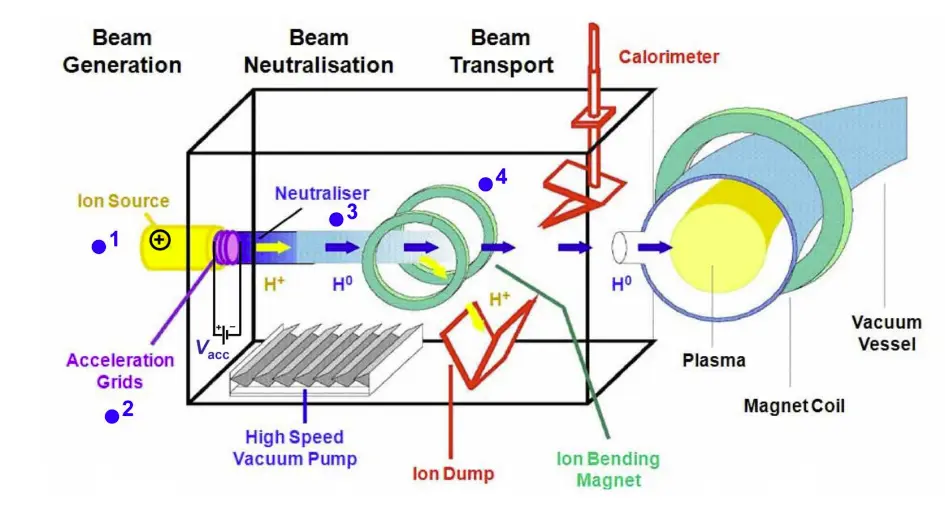
Image Credit: PLASMA HEATING IN PRESENT-DAY AND FUTURE FUSION MACHINES, Yevgen Kazakov, Dirk Van Eester, and Jef Ongena Laboratory for Plasma Physics, LPP-ERM/KMS, EUROfusion Consortium Member, Brussels, Belgium.
Youtube clips
Fusion Pioneers Jon Wood - Heating plasmas to over 100 million degrees
The speaker monitors plasma performance and performs spectroscopy to measure plasma properties while running fusion pulses every 15 minutes. Their recent success in heating plasma to 100 million degrees with neutral beam injection, demonstrates the machine's promise for compact, clean energy and drives their passion for technical challenges and sustainable energy.
Fusion Reactor Explained: Heating Plasma To 100 Million °C
A fusion reactor produces energy by fusing light atomic nuclei such as deuterium and tritium at extremely high temperatures, creating plasma and releasing significant amounts of clean energy. Magnetic fields confine the plasma, while high-energy neutrons transfer heat into a shell that produces steam for electricity generation, aiming to provide a safe, sustainable, and virtually unlimited source of energy.